


This article will discuss common interview types and how to address gaps in employment during an interview.
Types of Interviews
You should be aware of many types of interviews conducted by employers so you can prepare for them. Whether you’re a seasoned professional or just starting out, understanding these interview formats can give you a competitive edge.

The most common interviews are traditional one-on-one interviews. In these interviews, one person interviews one candidate, allowing them to make an impression on the interviewer with their skills and resume. Traditional interviews typically involve a mix of behavioral questions, situational inquiries, and discussions about previous experiences.
Another common interview style is a group interview, in which multiple candidates are assessed simultaneously through group activities or discussions. This type of interview is typically used for screening and evaluating one’s teamwork, leadership skills, and interaction with others. In group interviews, it is important to show your ability to collaborate while also showcasing your individual strengths.
Panel interviews are also common and involve one candidate being questioned by a group of people, typically from different departments or levels within an organization. Generally, a panel will consist of 3-5 people. Each panel member may ask questions to assess different aspects of your suitability for the role. One tip for success you can use in a panel interview is to engage the entire panel during the interview. For example, you can tailor your responses to the background or experiences of another panelist, not just the one who asked the question.
It is best practice to be prepared for various interview structures. A few other types of interviews include:
- Informational or screening interviews: An informal conversation with a professional in a field or organization of interest to you. The primary goal of an informational interview is to gather information rather than to secure a job.
- Phone and video interviews: Virtual interviews have become increasingly common, allowing employers to screen candidates before inviting them for an in-person interview. It is also important to note that if you apply for a fully remote role, your entire interview process will likely occur virtually.
Preparing for Interviews
Now that you know the interview types, you may wonder, “How can I prepare for the interview?”
The first step is to research the organization to which you have applied. Researching the organization and its staff members can help you understand their mission, vision, and core values, which you can use to tailor your interview responses.
Preparing concise, compelling answers that highlight your relevant experience, strengths, and achievements is important. Consider writing down or typing out your response or bullet points to have available to glance at during the interview. Anticipate standard interview questions about your strengths and weaknesses, interest in the role, and why you are the best candidate.
Just as there are different interview formats, there can be variability in the types of interview questions you may be asked. Some questions might be more technical, explaining your expertise or skill level in a particular area. Other questions can be more situationally oriented and ask how you handled a specific incident or event in the past. Sometimes, interviewers use both technical and behavioral questions.

For behavioral and competency-based questions, such as, “Describe a time when you disagreed with a colleague and how did you resolve it?” You can use the STAR method (Situation, Task, Action, Result). When using the STAR method, you first identify and describe the situation that occurred (Ex. The disagreement with your colleague), then discuss the task you had to accomplish (Ex. Your role in the conflict) before transitioning into how you handled the situation (Ex. Steps you took to resolve the conflict) before ending by discussing how the situation turned out (Ex Results of the actions).
Using the STAR method to structure and prepare your answers and having key stories ready to share during an interview can help with the interview process.
Other best practices for preparing for interviews include:
- Quantifying your achievements to show the direct value you can bring to the role.
- Preparing thoughtful questions to ask the interviewers about the company, team, or the role itself.
- Potential questions may include: “What are some of the day-to-day tasks of this job?”, “What departments does this team work with on a regular basis?” and “How is job performance evaluated?”.
- Consider asking about company culture and growth opportunities, which show the interviewer your interest in a long-term role within the company.
- Dressing appropriately in professional attire that aligns with the standards of the business.
- This may include a button-down shirt, blouse, slacks, skirts, dresses, dress shoes, heels, flats, and other business attire.
- Even if you have a virtual interview, you should still dress professionally.
- This may include a button-down shirt, blouse, slacks, skirts, dresses, dress shoes, heels, flats, and other business attire.
- Planning how you will get to the interview and what time you will arrive. It is best practice to arrive at least 10-15 minutes early for an in-person interview. Consider your transportation method and if you need to allot more time.
- For virtual interviews, ensure that you log on 10-15 minutes early to avoid technical issues.
- Following up with an employer after an interview is imperative. Sending a thank you email to the interviewer(s) shows your gratitude for the opportunity and reaffirms your interest in the position you interviewed for. In the email, briefly mention any key points or takeaways from the interview.
Addressing Employment Gaps
A common challenge when preparing your job interview materials is addressing any employment gaps on your resume. Whether due to personal reasons, career changes, economic challenges, or something else, gaps in employment will be asked about during an interview.
It might come in the question of, “How did your last role end?”, “What was the cause of the employment gaps on your resume?” or “Have you been looking for work?” When answering these questions, it is important not to panic. Employment gaps are a natural part of many career journeys and can happen for various reasons. These include personal motivations, such as raising a family or dealing with individual or familial health issues; career changes like industry change, pursuing further education, and starting a business; or economic factors, such as job market challenges, being laid off, or restructuring.
Some steps for best addressing these gaps include:
- Maintain your honesty and transparency without going into detail.

- Discuss what you did to fill the gap and what you learned during the gap. Perhaps you volunteered, did freelance work, or learned a new skill or trade.
- Briefly explain and reframe the conversation to focus on your achievements if needed.
- Clarify your boundaries. It is okay to say, “I’d prefer not to go into more detail; I would rather talk about my work experience.”
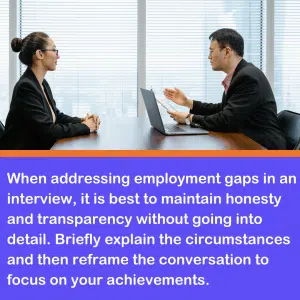
Below are some examples of ways to reframe your response. No matter how you respond, be honest and focus on the positive aspects of the situation.
- Personal Reasons: “I took a brief hiatus from my career to prioritize my family. During my time away, I maintained my skills through (volunteering, upskilling, freelancing, etc.), which allowed me to stay engaged professionally. I am now eager to rejoin the workforce with a renewed focus and commitment.
- Restructuring: “Unfortunately, my previous company underwent restructuring, eliminating my position. I am very grateful for my time at the organization and the experiences I gained. During my time away from work, I stayed productive by (upskilling, networking, consulting/freelancing, etc.)
- Left Role: “The company and I decided to amicably part ways because of confusion and unclear requirements for what was expected of me. In saying that, I still hold them in high regard, and I learned a lot from my experience at (name former organization) that I can use at (name organization you are applying for), such as (list skills).
- Career Changes: “After my last role, I deliberately paused to explore a different career path and clarify my career goals. I used the time away to focus on development and pursue education. I enrolled in (name of course) to enhance my skills in (learning area), which I believe will be valuable in this role.
Resources
- How To Make a Great Impression in a Job Interview: 20 Tips | Indeed.com
- How to Explain Gaps in Employment (umassglobal.edu)
- Types of Interviews
- How to Explain Gaps in Employment
- How to Use the STAR Interview Response Method
- Competency-Based Interviews
- Behavioral Interview Questions with Sample Answers