


Navigating the transition from college to the workplace can present unique challenges and uncertainty about what to expect. The job search process and workplace differ in many ways from academic life, including task management and social interactions. In this article, we will share some strategies for successfully navigating these new challenges.
Jumping into the Job Search
If you have recently graduated or will graduate from college soon, congratulations on this significant accomplishment! Take some time to reflect on and celebrate all the incredible milestones you have reached. Along with the feeling of excitement, you might also feel unsure about what to expect or how to approach the job search.
 When tackling the job search, a good first step is to develop a well-crafted resume and cover letter that highlights all the valuable education, skills, background, experience, and qualifications you gained throughout college. If your university provides career services, inquire about resume writing and interview preparation support.
Alternatively, consider signing up to work with a Hire Autism Navigator for virtual job search support.
Furthermore, seeking professional development and continuing education opportunities can give you new skills to put on your resume and increase your marketability. For example, you could take upskilling courses or earn a certification online to expand your knowledge, expertise, and skills within the field you want to enter. Education extends well beyond graduation, and committing to lifelong learning can help you advance personally and professionally.
To learn other strategies for improving your overall job search, read our previous articles:
- Understanding Keywords and Applicant Tracking Systems
- Why a Tailored Resume and Cover Letter are Essential to Your Job Search
- Making the Most of Career Fairs
Once you have successfully landed a new opportunity, it’s time to shift your focus from the pursuit of employment to making a strong impression in your new position. Let’s explore how you can effectively integrate into your new environment.
On-the-Job Strategies
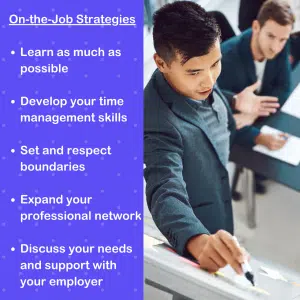 After landing a job, your goal within the first 2-3 months should be to learn as much as possible. Asking questions, requesting feedback, shadowing, and working with a mentor are good strategies for learning the company culture and how to succeed in your new role. This approach is similar to the collaborative environment you may have experienced with professors and classmates in college. Much like asking for guidance from your professor or working with your fellow classmates to understand your course material better, you can apply the same principles to your new workplace.
Time Management
During this transitionary period, you may notice that you now have more autonomy over your schedule than in school. Developing your time management skills, including prioritizing tasks and setting clear goals, can be critical to continued success in your new role.
Try these tips for developing your time management skills:
-
- Identify your most important tasks and deadlines
- Use tools like to-do lists or digital planners to keep track
- Break larger projects into manageable steps and allocate specific time slots for each task
- Minimize distractions and focus on one task at a time
- Regularly review and adjust your schedule as needed
Professional Relationships and Networking
Creating interpersonal relationships may also look different in the workplace. While meeting new colleagues, you should set social boundaries professionally and courteously. This can include clearly defining and communicating your limits on personal space, time, and interaction. Start by letting colleagues know when you are and are not open to socializing during work hours. Respect others’ boundaries similarly and avoid engaging in conversations or activities that might be seen as intrusive.
Still, do not be afraid of building strong social connections! Positive professional relationships can benefit your career and help you form the foundation of starting a professional network. By creating this network, you can learn more about the industry, establish friendships and mentorships, volunteer or showcase your skills, earn recommendations from others within your field, and, perhaps, open some doors to paid opportunities or even full-time employment.
Other valuable individuals to include in your network include individuals from school and previous jobs, such as professors, classmates, and supervisors. These individuals can often lead to future job opportunities and be strong references. Additionally, services such as LinkedIn are a great way to expand your professional network.
Remember to be kind to yourself as you navigate this transition and take time to discover what works for you. Keep the lines of communication open with your employer, discussing your needs and seeking support as necessary. Your first job doesn’t have to be your last, so give yourself the space to grow and explore.
For more insight into the challenges and opportunities presented to autistic college students during the transition from higher education to the workplace, watch OAR’s webinar, The Transition from Higher Education to the Workplace for Autistic Students, presented by Emily Raclaw, M.S., LPC, CRC, and Molly Conners.
Advice Submitted by Hire Autism Navigator, Brigit P.
- Join a Professional Association: Professional associations offer networking, job opportunities, upskilling, and industry expertise. They provide insight into various career paths and possibilities you may not have considered.
- Managing the Transition: The period between graduation and securing your first job can be anxiety-inducing. Consider enlisting a mentor for professional and personal guidance. Create a roadmap with your mentor to establish short and long-term S.M.A.R.T. goals. Regular check-ins can help you identify and overcome any obstacles.
- Stay Adaptable: In today’s rapidly changing world, flexibility and openness to various opportunities are essential. Be open to different types of roles, including part-time, contract, or temporary positions. These roles can offer valuable experiences, industry exposure, and growth opportunities.
- Emotional Intelligence (EQ): Developing self-awareness of your Emotional Intelligence (EQ) is vital to workplace success. The five components of EQ—self-awareness, self-regulation, motivation, empathy, and social skills—are crucial. Free online inventories can help you assess and improve your EQ. Start by understanding your strengths and weaknesses in these areas. Work with your mentor to obtain feedback and strengthen your EQ.
Resources
- Exploring the Gap Between College and Career
- The Challenging Transition From College to the “Real World”
- Navigating the College-to-Career Transition: Key Challenges and Effective Strategies
- 11 Tips for Transitioning from College to the Workplace
- Navigating the Transition from College to Career: A Detailed Guide to Success