


With the increased use of Artificial Intelligence (AI), it is crucial to understand the benefits and drawbacks of using it in the job search process. This article will provide suggestions on how you can use AI to make your job search more efficient and help you learn about the opportunities and disadvantages posed by AI.
Job Matching
Using AI can significantly reduce the time and energy you put into searching for a job. Have you ever logged in to a recruiting platform to find dozens of jobs matching (or loosely matching) your qualifications, experience, and interests? This occurs due to the assistance of AI in providing enhanced job matching.
Some career sites leverage AI to provide more customized and personalized job opportunities based on your skills, experience, and needs. Mentra is an example of an organization that harnesses AI to improve the user experience. Their approach of using AI recommendations to connect job seekers to employers has “maintained an impressive 97% retention rate for pre-screened candidates,” and they “have seen 79% of recommended people receive interview invitations.”
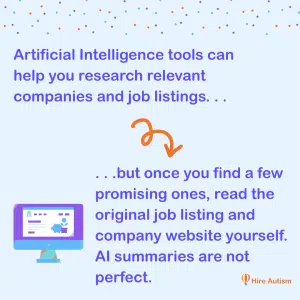 If you are unsure about which opportunities you may be looking for next, consider using a platform or organization that leverages AI to offer enhanced and customized job matching. It can provide tailored recommendations unique to you and help you assess the direction you would like to take in your career.
You can also use AI to quickly research and learn about the company you are applying to (although you should always visit the actual site, as companies can change over time), such as its culture, size, mission, values, and goals.
While AI can optimize your search for the next job you would like to apply for, it is still critical that you read through and evaluate the job descriptions it recommends before applying. This key step can improve your chances of applying to a job that best aligns with your skills and needs and finding an organization that aligns with your values. To learn more about navigating job descriptions, read our previous article, Decoding Job Descriptions: Support for Autistic Job Seekers.
Writing and Proofreading
Your job search documents, such as your resume and cover letter, are a core component of any job application and are often the first impression a candidate can make on an employer. They showcase your accomplishments, experiences, and skills you possess. As such, having an organized, readable resume with minimal mistakes is essential, and AI can be an effective tool to start crafting a well-worded resume.
If you are unsure how to start putting together your job search documents, there are various AI resume builder platforms and cover letter generators that can help.
If you already have a draft of your resume and cover letter, AI can help you quickly proofread these documents and offer suggestions for optimization. Some examples include:
- Catching spelling and grammar mistakes
- Ensuring commas and other punctuation marks are used and placed appropriately
- Recognizing present vs past tense
- Catching capitalization errors
- Identifying passive tense
While AI can provide recommendations to make your job search documents match the job descriptions perfectly, it does not know your work history, experiences, or tasks you did at your previous jobs. It is up to you to ensure the information you submit to employers is honest and accurate.
Lastly, AI lacks personalization and doesn’t fully capture the scope of your experience and skills; instead, it gives you a generic response to a generic prompt. If you rely on AI alone, it is a missed opportunity to showcase and sell yourself to a potential employer.
Networking
Networking, even virtually, can be overwhelming. There are so many exhausting components beyond just the soft and social skills involved. What do I say? How do I say it? Am I even supposed to be here? Am I meeting the right people? AI can help ease some of these fears and anxieties.
One of the most effective professional networking platforms is LinkedIn. Millions of employers and recruiters from all over the world use the platform to look for potential candidates. Therefore, building your professional presence in this space is a good opportunity to be seen.
A strong “About” page is a great starting point for making your LinkedIn profile more attractive to recruiters. Try writing this section with an AI tool such as LinkedIn’s AI system, ChatGPT, or GoblinTools! This segment offers you the opportunity to describe your industry experience, vision, goals, and career aspirations. AI can be very helpful when crafting your pitch in a clear, articulate, and concise way.
Cold messaging can be a scary prospect for many people. LinkedIn helps with this by offering generative AI prompts, which you can tailor and tweak as you see fit. To do this, you would go to one of your contacts or previous messages on LinkedIn. You might see a few auto-generated responses below the last message sent. For example, if someone wishes you a “happy birthday,” some options you might see are “thank you,” “thanks,” or “thank you, I hope all is well with you.” These prompts can help you formulate your outreach and responses and expand your professional network.
Finally, a recent feature has been added in which you can draft a post and use AI to capture the most important parts of your message and professionalize it. To use this feature, you would start drafting a post on LinkedIn by clicking “Start a Post” and write a blurb over 20 words long. After which, you would then click the “Rewrite with AI” button, and AI will revise, edit, and professionalize your post.
Interview Preparation
If you find interviews challenging, AI can assist you with preparing for them. There are various interview simulator platforms and generative AI that can:
- Provide different interview scenarios and questions
- Provide questions specific to a particular role or industry
- Generate potential interview questions
- Help with generating ideas for answers
- Provide immediate feedback on your responses
This can help you practice your talking points and gain valuable insight into strengthening your answers.
It is important to note, however, that whilst AI can be a useful tool for practicing interviews, it is also important to be genuine in your responses during an interview.
Considerations
While AI can be a useful accommodation, it is not perfect, and it cannot substitute your authentic voice. And as such, it is best practice not to be overly reliant on it.
For instance, when using AI to check your writing, you may have accidentally spelled the word “united” as “untied,” but because “untied” is a word, AI may not offer a correction. It might also struggle to understand the context in which specific phrases are used. For example, it might change a word you intended to a synonym if you had used the word multiple times before, even if that synonym does not match the tone of your paper.
Precautions to take when using AI include:
- Educate yourself on the use of AI and various risks
- Closely review and revise your job search documents after using AI to create or edit
- Do not incorporate suggested changes if it is inaccurate to your experience and skills
- Double-check any information provided by AI to ensure it is not outdated or inaccurate
All in all, AI can be a helpful place to start writing your job search documents, quickly build a professional networking profile, more efficiently apply for jobs that match your qualifications, and more; however, AI edits should be reviewed by the user to ensure it is accurate and truthful.
Resources:
- 5 reasons Why AI Won’t Replace Proofreaders and Editors
- 5 Ways Grammarly is Useful for Proofreading Resumes and Cover Letters
- How AI can Make Networking Easier and Less Awkward
- The Impact of Artificial Intelligence on the Job Search
- Mentra.com
- The Future of Work is Neurodiverse
- Microsoft: Accessibility and Innovation
- How to Use GenAI to Prepare for your Next Job Interview
- Turn Pre-Interview Jitters into Confidence with AI Interview Practice Platforms
- Using AI in your Next Job Search: Helpful or Hurtful?
- How Students Should Not Use Generative AI in the Job Search
- Job Winning Resume Templates